Curator
Jernej Kožar
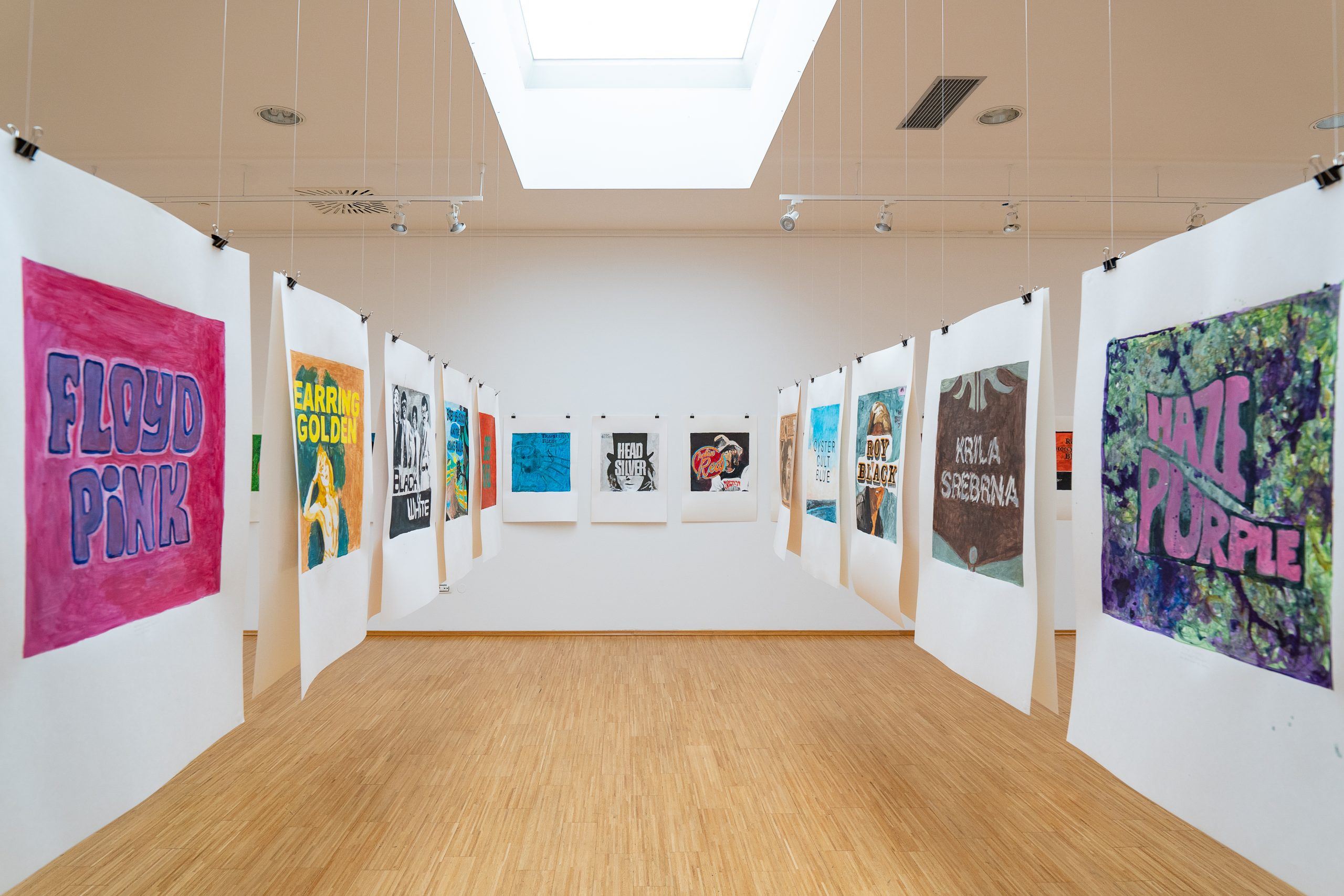
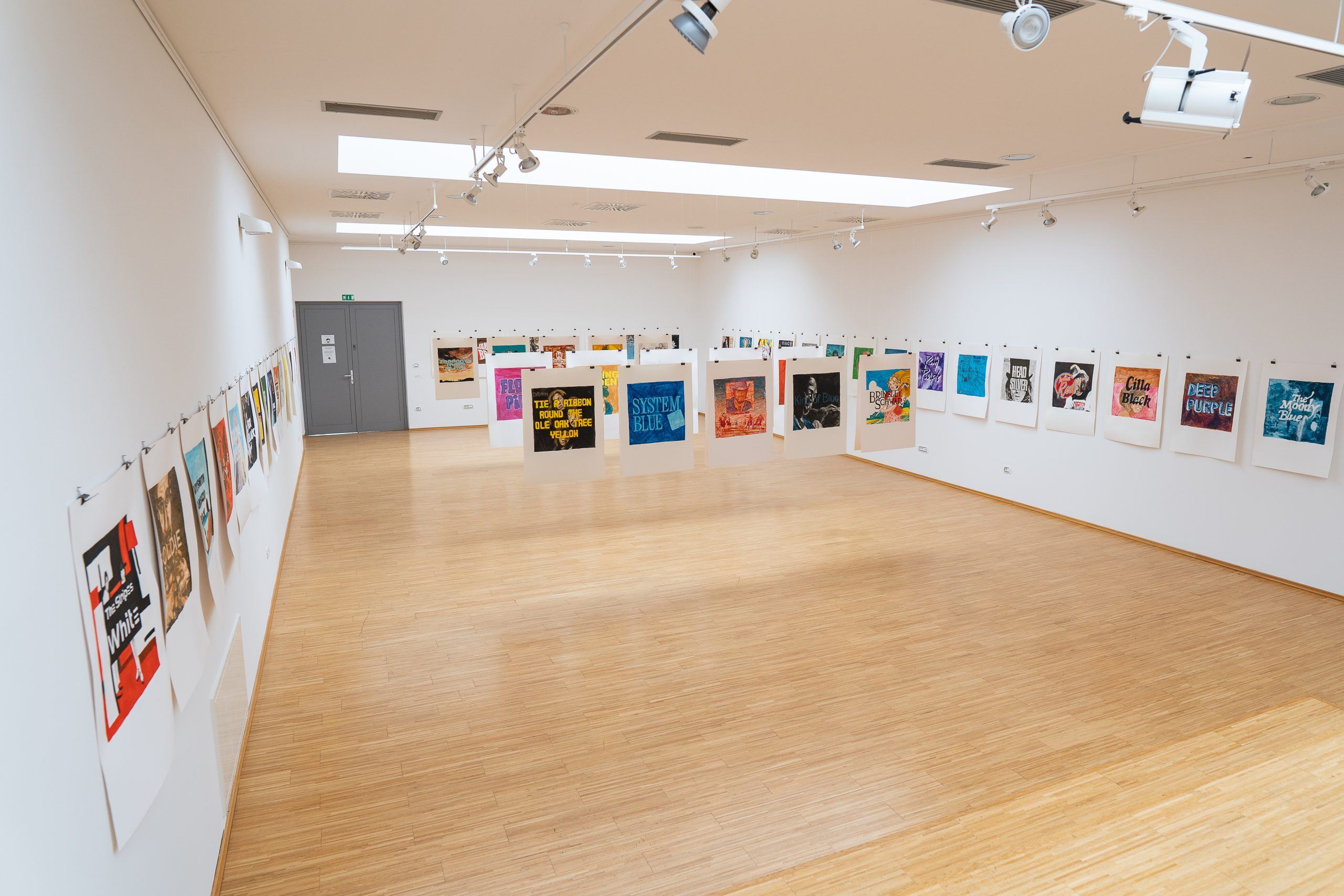
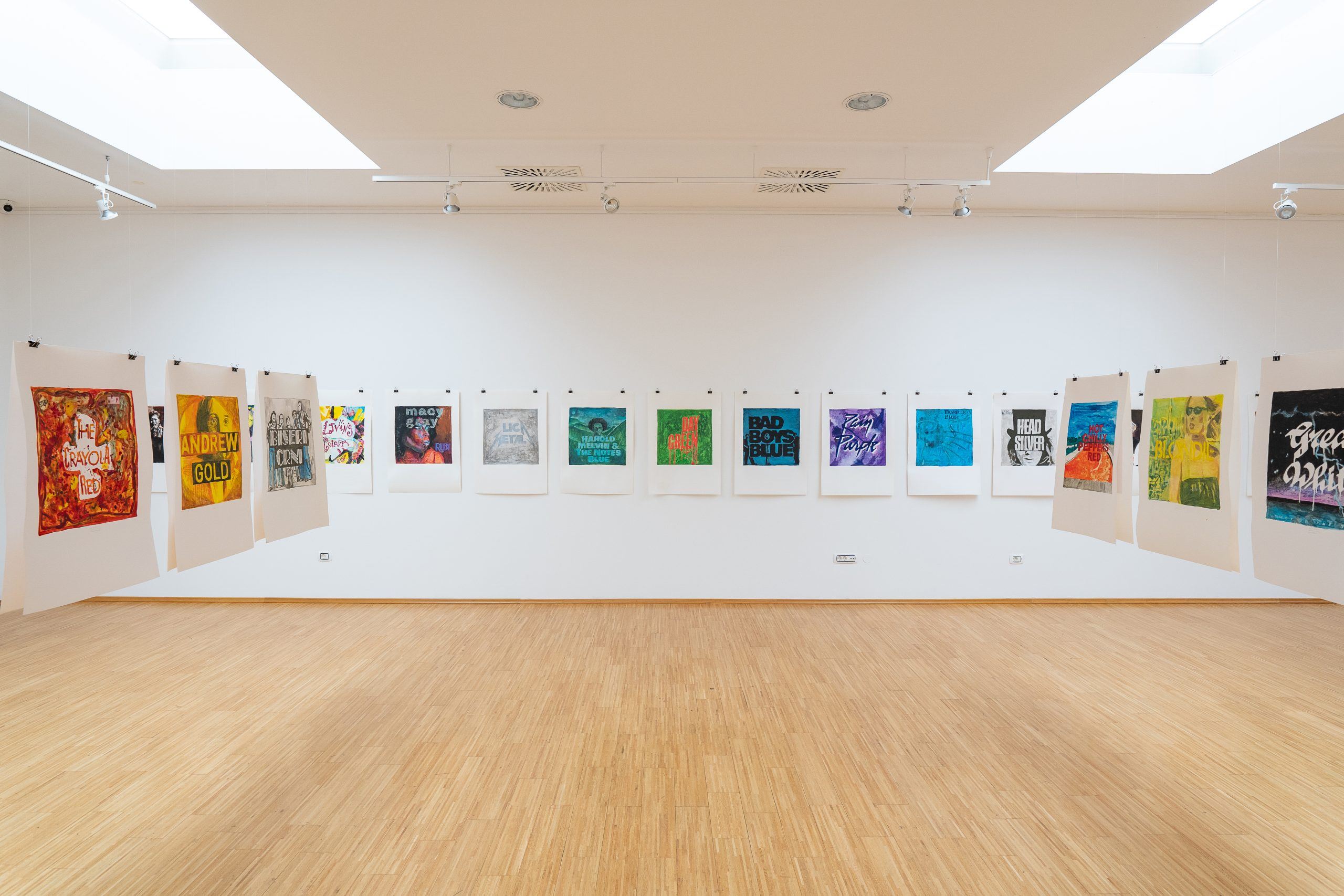
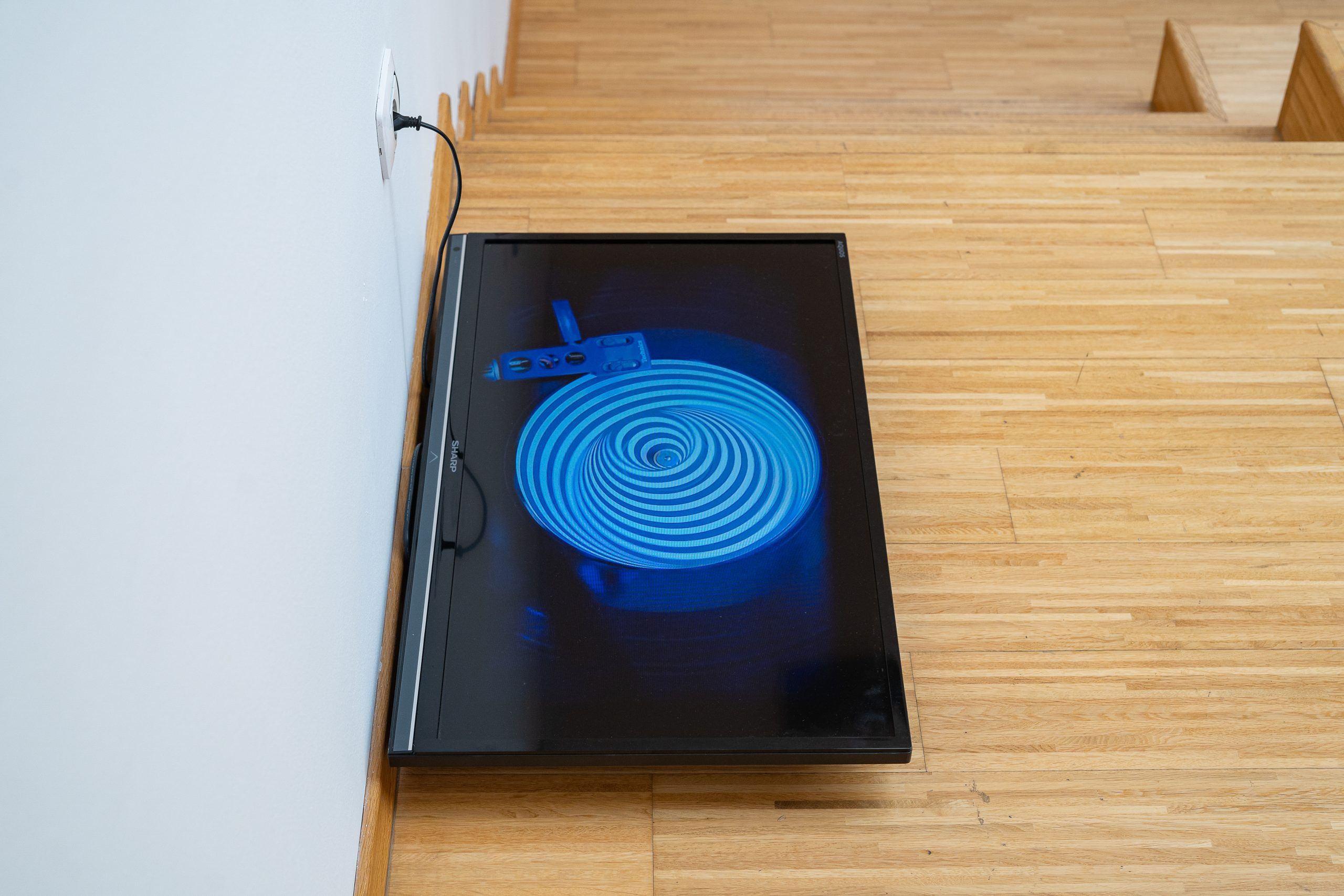
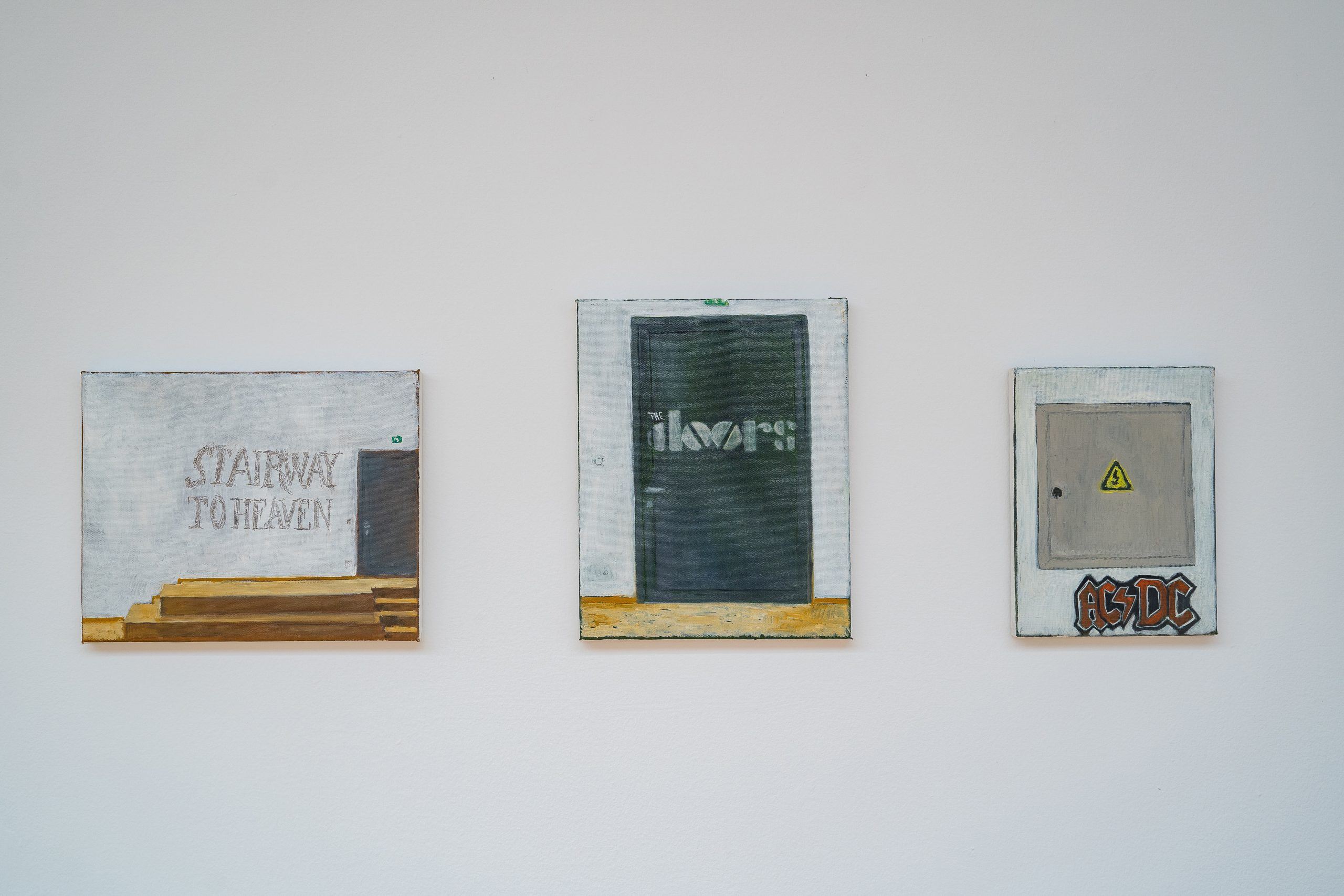
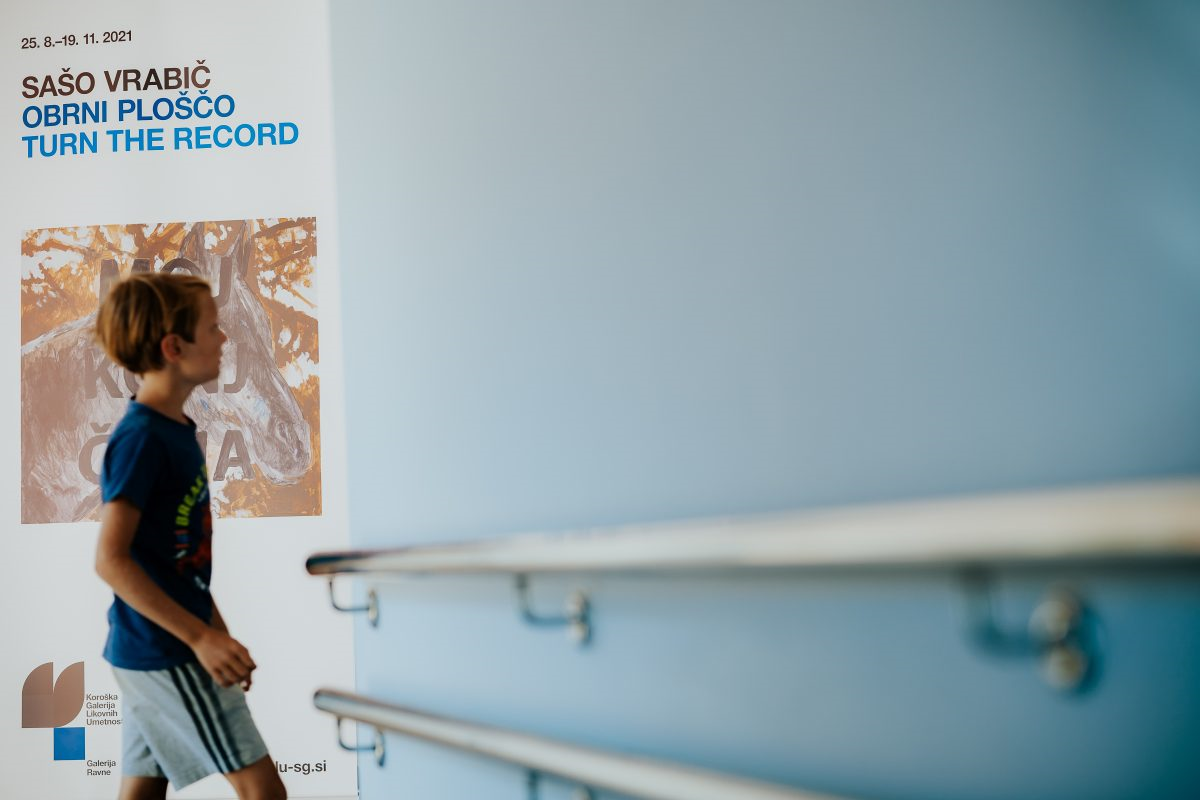
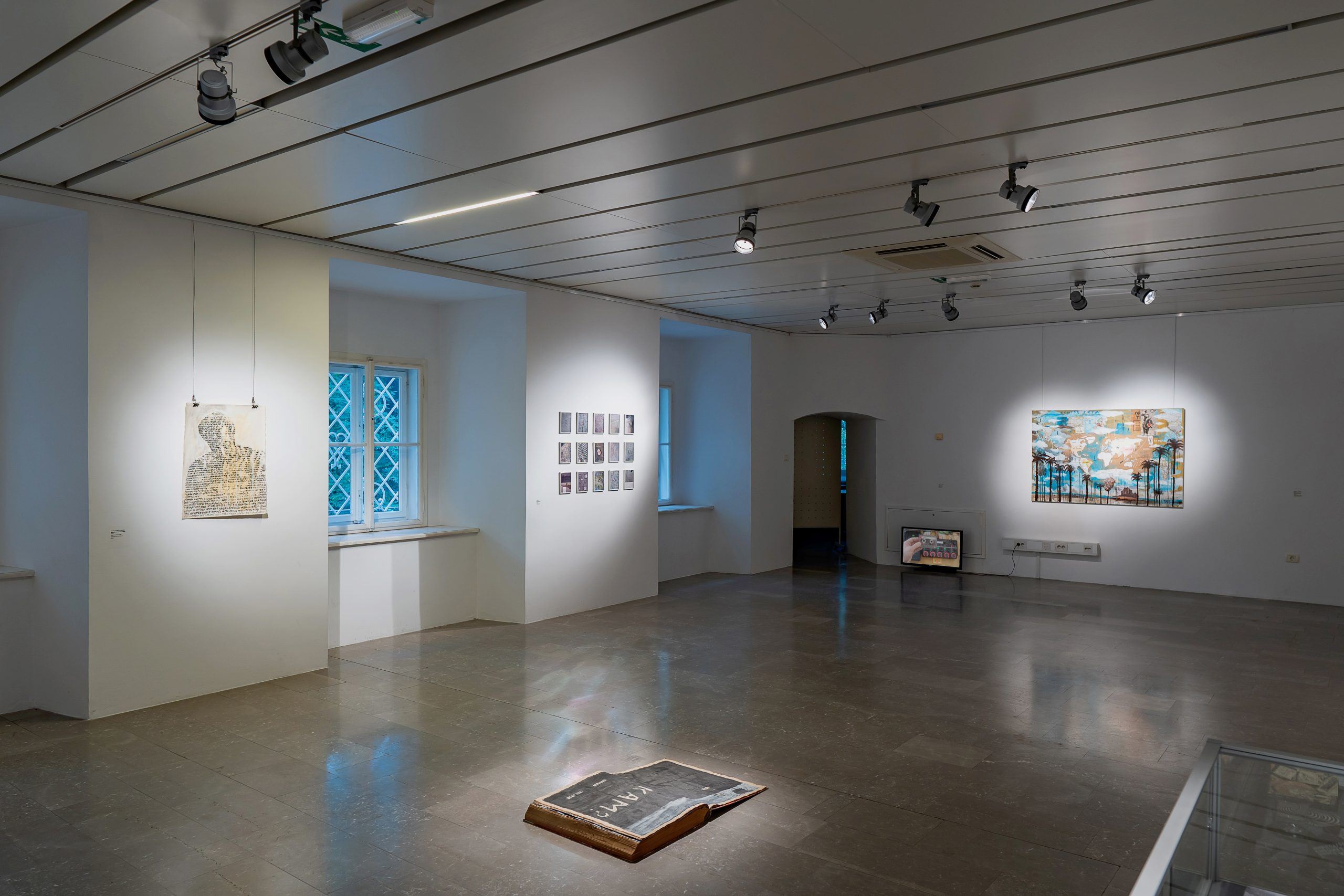
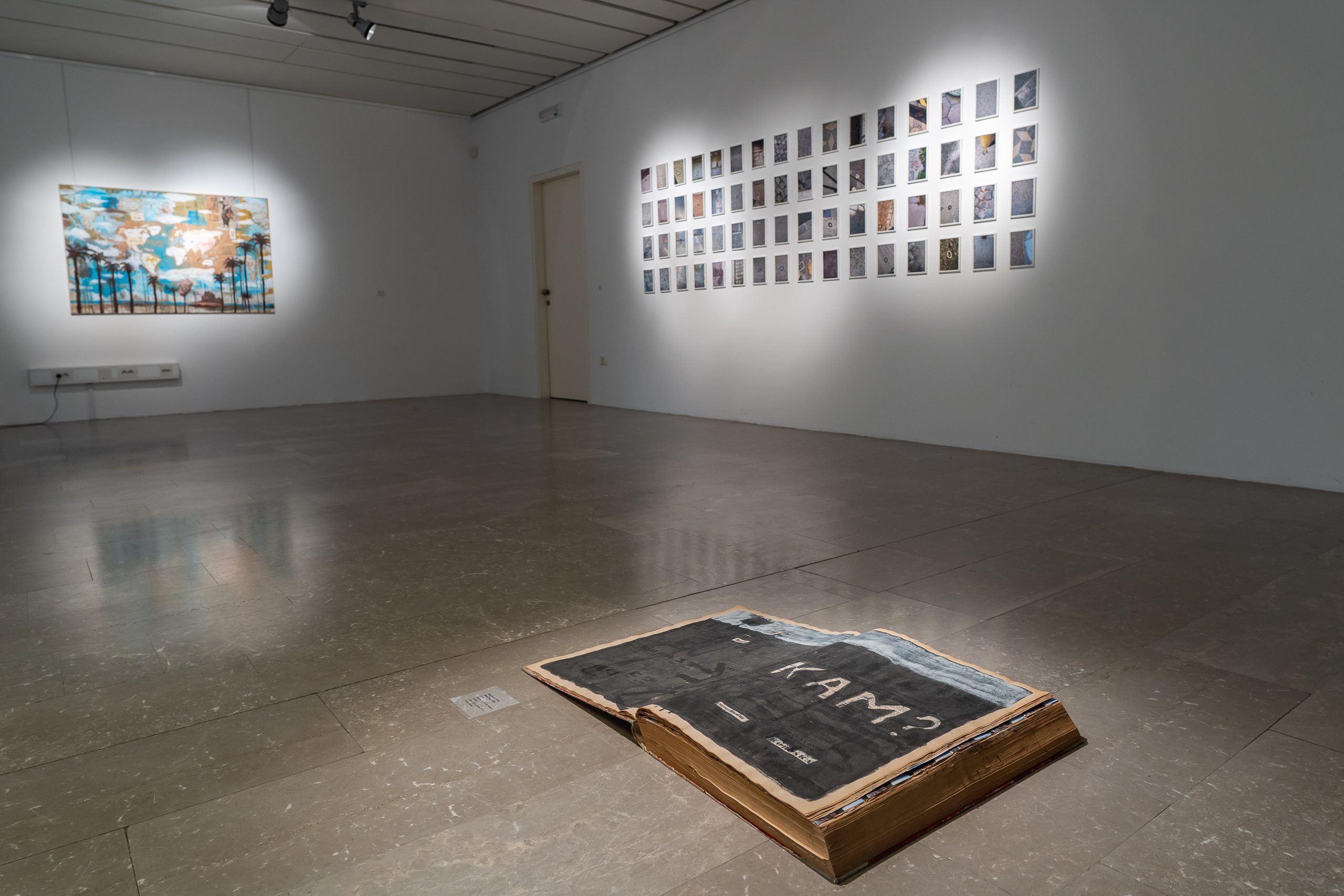
Sašo Vrabič’s exhibition Turn the Record was held in two venues: in the Ravne Gallery and in the exhibition hall of the Dr Franc Sušnik Central Carinthian Library. The Ravne Gallery exhibited paintings on paper called Covers (True Colours) 2020-21, and next to them the paintings Homage to the Exhibition Venue (Tryptic): Stairway to Heaven, The Doors, AC/DC", 2021, and the audio video Eppur si muove, 2020-21. In the second venue, the series of photographs Rubber Bands, 2019-21, music videos from the series Tape Loop, 2021, in which drawings, artist’s books, sketchbooks, multiples and various graphic designs were exhibited.
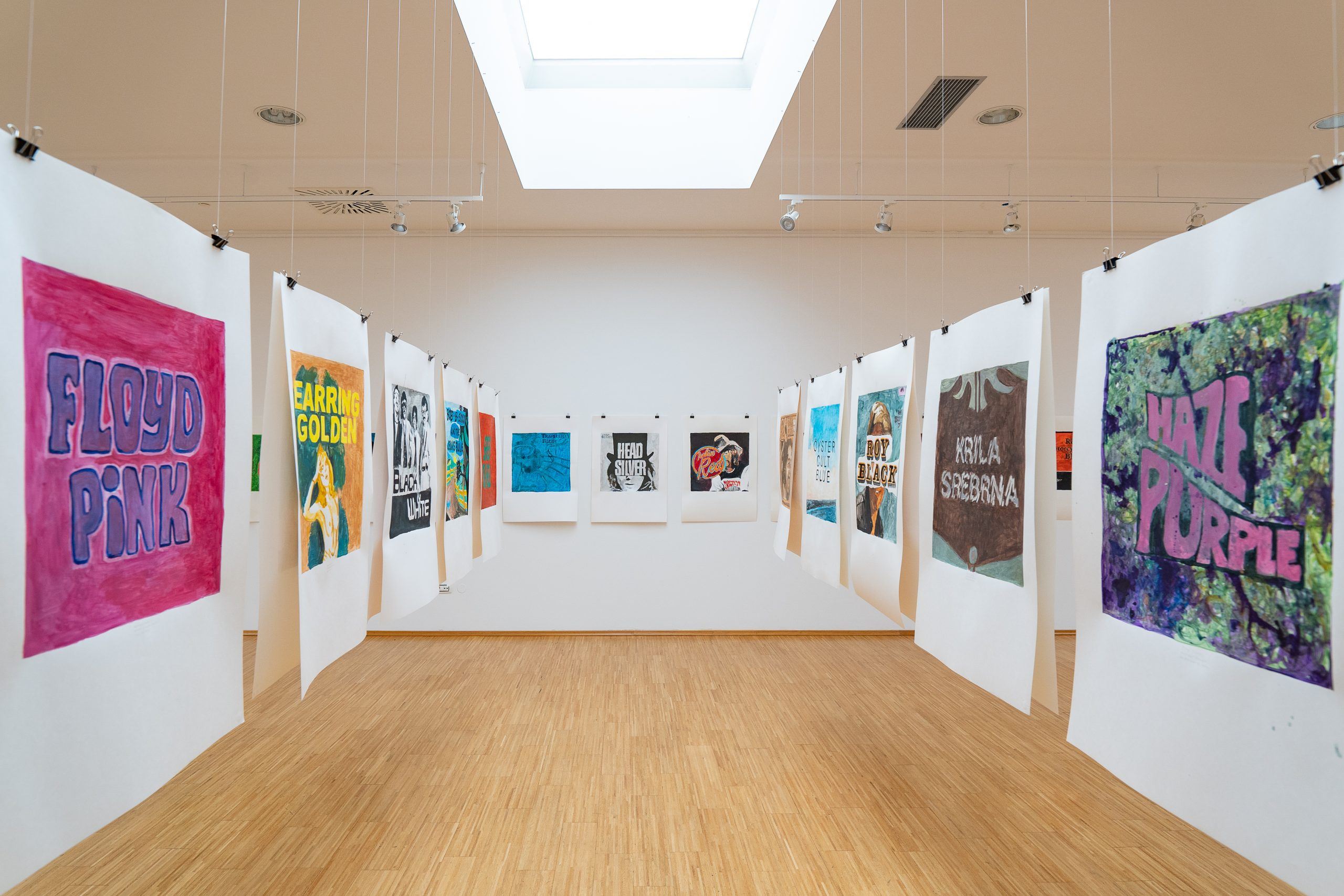
In the Ravne Gallery, the layout recreated the intimate atmosphere of a record store. The pictures fluttered seemingly carelessly in the room, reminiscent of posters when these hang from the walls half-unstuck. This impression was accentuated by the crackling sound of the vinyl record as the needle skips at the end when the cueing lever does not automatically return to its starting position. The video Eppur si muove repeats this exact moment.
The paintings titled Covers (True Colours) depict adaptations of LP covers by several music artists from the pre-digital era. The colours in the album title or band name are the true colours that inspired the painter to choose these covers. In the paintings, the inscriptions are often changed, such as the clever anagrams of the musical group or artists’ names, in which Vrabič focuses on descriptions of colours or expressions from painting terminology. The typography follows the original, thus enabling the easier recognition of names. Some melodies are easy to recognize, some ring in our ears, with others we just smile at the author's imagination when he plays with the name of the band or the title of the album. In some places he changed the order of the words in the title or changed one of the words, for example Rain to Pain or My Black Horse to My Horse Black. Other covers are literal, such as Kind of Blue, as they are ambiguous or metaphorical enough on their own and thus do not require further interpretation and alteration. For example, Cilla Black, whose real name is White. Elsewhere, it is merely a distant paraphrase of the band’s name (Green Day, Deep Purple): that which is meant metaphorically, Sašo Vrabič takes literally and establishes the primary level of communication known from proverbs, as evidenced by the title of the exhibition Turn the Record.
The LP covers speak of some other time before YouTube, when we used to listen to music in the privacy of our homes and did so in its entirety, meaning the whole album. The 83 covers can be a brief history of 20th century music, ranging from classical to pop, and rock to punk, from pop producers to borderline art groups. Many bands have been associated with art not only through the design of their album covers, but directly, such as The Red Crayola. LP covers were often created by important artists: for Black Flag Raymond Pettibon, for The Beatles, the White Album, Richard Hamilton, etc.
The style and manner of creation of these works are reminiscent of musical creation. Just as a musician recreates the basic melody or note of a composition, Sašo Vrabič as a painter recreates the atmosphere of the LP cover. Each of the Covers (True Colours) is accompanied by a haiku. With this, the painter, now a poet, completes the covers with a fleeting poetic form, loaded with layers of meaning. However, he does not do this with the intention of further complicating the sufficiently complex code of contemporary art, but rather to simplify it, so that it could be more widely understood. The purposefully chosen painting style, which is non-academic and simple, also contributes to this. The fleetingness of moments contained in haikus is the quality that binds them to the LP covers, likewise trapped in the creative periphery.
Vrabič depicted parts of the gallery in the triptych Homage to the Exhibition Venue (Triptych): Stairway to Heaven, The Doors, AC/DC. Stairway to Heaven is, of course, the steps of the landing that adorns the white space of the gallery, The Doors are the additional doors of the exhibition space that lead to another space, and the picture of AC/DC depicts the doors of the electrical cabinet. By depicting these details of the space, the artist introduced a new twist in the perception of the exhibition. Three small paintings explore the variability of the observer’s purgatory. We are faced with a one-way reading of the image, which prevents us from established means of social communication, which is always metaphorical. These three small paintings are an explanation for the rest of the works in the exhibition: they depict exactly what we see. The painter’s artistic intervention, as before, focuses on the selection of motifs.
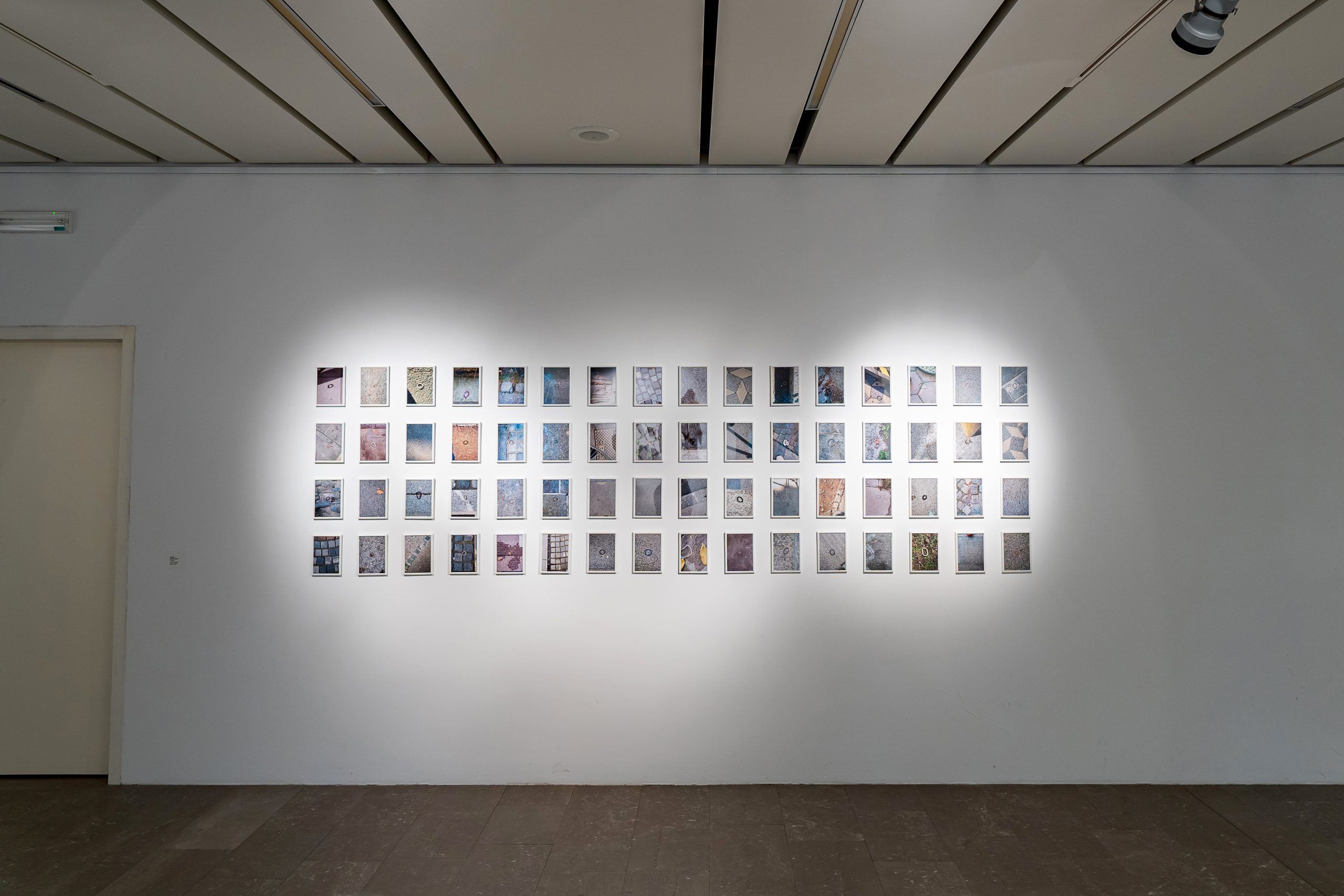
At the second venue in the exhibition hall of the Dr Franc Sušnik Central Carinthian Library, the focus of the exhibition Turn the Record was on the series of photographs entitled Rubber Bands. In the photos, we follow discarded or lost hair bands. These lie carelessly on the floor, where they fell when they lost their original purpose. Here, the photographer captured them and with an artistic gesture held back their transformation into trash, their downfall. The ephemerality of their existence is used for artistic purposes, as depicted in this way, they acquire real connotations, much like haikus. These rubber bands are round, and thus describe a closed circle, a graphic mirror image of haikus, which are also a closed parable of creation. The circle motif is also perpetuated by the video Tape Loop 1-2. Repetition of patterns has a graphic and grammatical meaning in visual arts and music. Here it can be compared to the repetition of our daily tasks and somewhere far away perhaps also to the labours of Sisyphus.
The hair bands emphasise the intimacy of the setting, as already seen in the Ravne Gallery; they lie on different surfaces and always occupy the central place in the photo. The texture or pattern of the floor can further stimulate our imagination: a rubber band on parquet may tell an erotic story of undone hair, while a rubber band on a background of granite cubes may speak of broken relationships, a rubber band on sand may tell a tale of happiness, and a larger fabric rubber band perhaps of bushy hair styled for a special occasion.
These rubber hair bands carry the history of hair as a key human attribute: from Samson and Delilah to the modern fashion of straightened hair. Hair has played an important role in all cultures and historical periods and can also be a status symbol, which is evident today in the prevailing fashion of smooth long hair, which even black women tend to follow, albeit with great pain and sacrifice.
Delo (year 1974), 2014, is a book by artist Sašo Vrabič. The painter used a bound 1974 edition of the Delo newspaper as a basis. He painted over some pages with black, in other places he only underlined the words and only left certain article titles visible. Thus, he created an intimate interpretation of the year in which he was born. Sketchbook London (2010-4) brings extraordinary felt pen drawings and coffee watercolours. Brilliant compositions of still lifes, framed in sharp foreshortenings and drawn in an accentuated realistic manner, capture the observer with their drawing full of contrasts and with the filling of the space, from which the atmosphere of the local cafés emanates.
The artist’s lucidity and ability to recognise the seemingly ephemeral details of our lives is common to both settings. The exhibition held in the exhibition hall of the Dr Franc Sušnik Central Carinthian Library was set up as a comprehensive exhibition of Vrabič’s work created in the last decade and adapted to the space. It appealed to the viewers with the breadth of the author's artistic approach. The Turn the Record exhibition has become an interesting meeting point of various aspects of contemporary art – the depiction of the marginal, the repetition of patterns as a metaphor for our lives, and the search for the poetry of the ephemeral.