Curator
Kristina Ferk
Automaton – The Master Controller?
How much of our decision-making can we entrust to automated systems that use artificial intelligence without losing our capacity for independent judgement? Who assumes responsibility for decisions made with the help of these systems, and for their consequences, when automated systems operate with ever less direct human intervention? Perhaps the question is no longer whether humans can choose, but how free our choices are when a system has already filtered the information and formulated the options from which we choose. And how can we assess the consequences when the system’s behaviour is becoming increasingly difficult to predict?
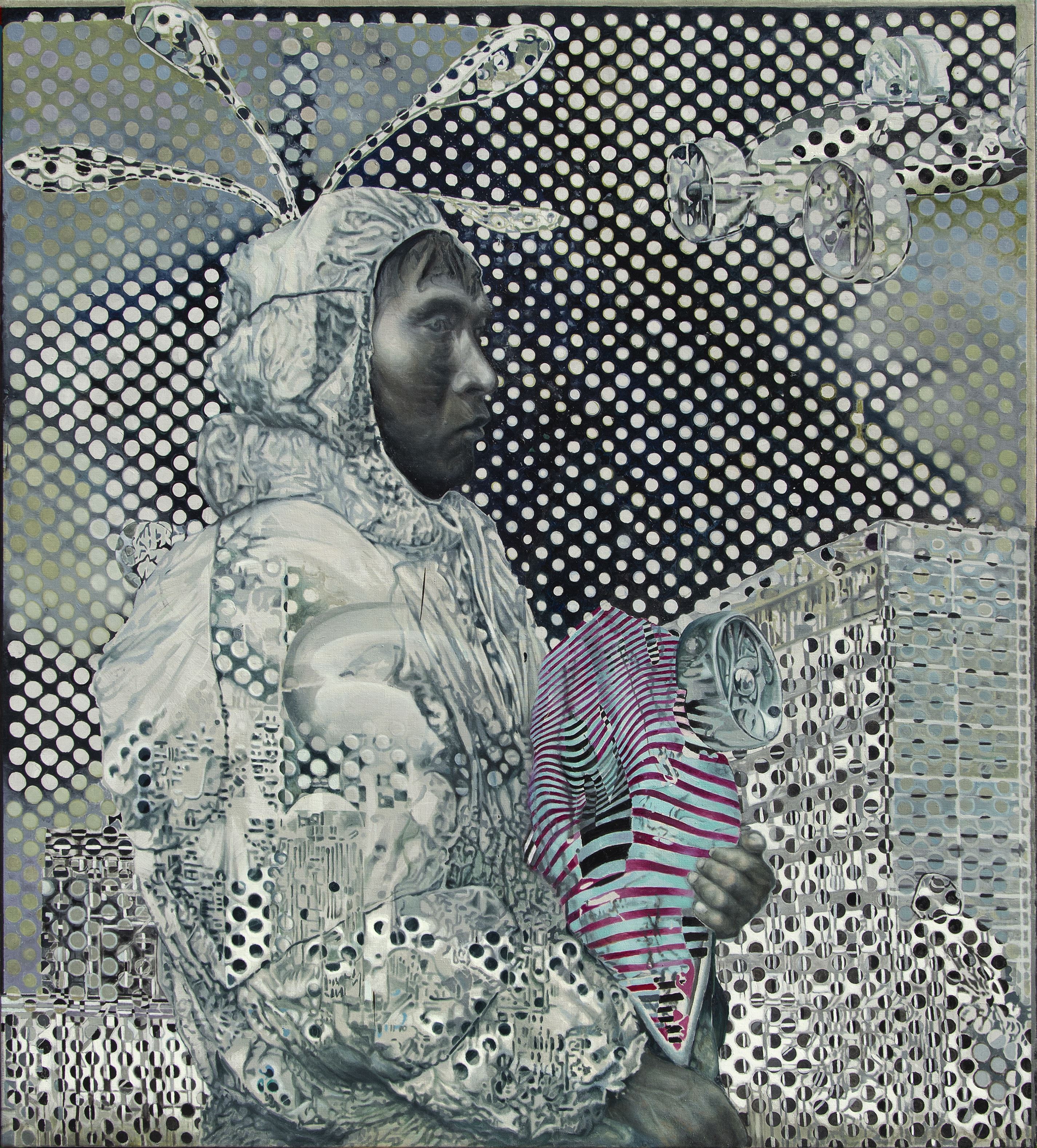
In works created between 2025 and 2026, Uroš Weinberger explores these questions through ambiguous images that, along with other possible interpretations, play with our perception of time. Among the visual sources from which he constructs his initial compositions, later translating them into painted images, are motifs taken from photographs from the 1960s, 1970s and 1980s. Yet the resulting images can paradoxically appear as archival records of the future. Temporal uncertainty is also embedded in the artist’s painterly language. Grid and dotted halftone patterns create optical vibration and destabilise the image, while figures at times disintegrate and merge with their surroundings, as in Disclosure, Museum of Natural History and Nuclear Winter. The scenes remain recognisable, yet they elude the familiarity and certainty with which we are accustomed to viewing the world.
At first glance, Weinberger’s scenes appear to be glimpses of a dystopian future, but in fact they bear witness to the spirit of the present day – our Zeitgeist. This is characterised, among other things, by exponential technological development; a technological messianism that, in the name of the future of human civilisation, overlooks current social crises; uncertainty surrounding the development of artificial intelligence; ecological threats; and the dangers associated with nuclear weapons and energy production. All these allusions, reflected in Weinberger’s works, are far removed from carefree ease. On the contrary, the works are permeated by anxiety and a somewhat unsettling sense of estrangement.
In the most recent cycle, ecological anxiety and solastalgia intertwine with the human drive towards self-sufficiency and progress in an age of artificial intelligence. Technology promises ever greater independence and an improved standard of living, yet its operation requires infrastructure that consumes enormous quantities of energy and natural resources, as suggested by the fully industrialised landscape depicted in The Cloud. According to 2025 data from the International Energy Agency (IEA), a typical data centre dedicated to artificial intelligence consumes 100,000 households-worth of electricity. This consumption forms part of a broader pressure on the environment: from the extraction of raw materials and emissions that contribute to global warming to the degradation of local ecosystems. Weinberger’s canvases thus reveal a contradiction at the heart of our time: we seek to overcome our own limitations through technology, while becoming increasingly dependent on infrastructure whose operation threatens the environment on which our lives depend.
The irony of this relationship with nature is also revealed in scenes of “paradise gardens” and holiday destinations, such as the one evoked by Palm House. After our everyday lives in concrete jungles, we yearn for contact with supposedly pristine nature, often presented as an idyllic place of escape. Weinberger introduces into this holiday paradise his now-established motif of flying drones, disrupting the sense of carefree leisure and suggesting a carefully maintained and controlled form of nature; precisely the kind of environment we seek to escape from. The work also raises the issue of mass tourism, through which local environments are adapted to visitors’ comfort and the demands of accumulating profit. Self-sown, wild and uncontrolled vegetation becomes part of the carefully curated image of “pristine” nature.
The individual astronaut figures in The Precipice and The Light Cone expose another, more speculative vision of the future of human civilisation. They can be connected to transhumanist ideas about digitally recreating the human mind in a virtual environment, allowing existence to continue without a biological body. This inevitably raises questions about whether such a version would still be the same person, and what material basis it would require for its existence. Such a virtual world would most likely require extensive software and energy infrastructure. In his essay Astronomical Waste, Nick Bostrom also considers the possibility of using resources beyond Earth. Weinberger’s astronaut figures in unfamiliar landscapes can therefore be interpreted considering the question of where such a search for resources might lead humanity, and what the colonisation of other star systems might look like.
What are we really trying to preserve through the technological promise of humanity’s future? A living, sentient body, its mental processes and informational record, perhaps memories, perhaps feelings?
The question of preservation is also addressed in Museum of Natural History. The title conjures up an institution devoted to collecting, preserving and interpreting heritage for the future. Yet Weinberger’s image once again places the viewer in a position of uncertainty. The central figure can be interpreted as an astronaut, a hybrid being or a trace of human civilisation. Its fragmented, mosaic-like appearance has an almost holographic quality. The ambiguity established by the title is further intensified, as it is impossible to determine whether the lush, self-growing vegetation survives only as a museum specimen, and whether the supposedly human figure has itself become part of the collection.
Weinberger does not seek to depict a dystopian future. His works return us to questions of the present: how much decision-making are we handing over to automated systems, what will be the consequences of our present actions, and how will we assume responsibility for them when the time comes? The title of the exhibition, Automaton, evokes not only a machine, but also a human being who acts mechanically and without reflection. In Weinberger’s works, fascination with technological development is intertwined with unease about questions of control and responsibility. Probably no one wishes for the kind of “paradise future” that Talking Heads wryly sing about in their 1988 song (Nothing But) Flowers.
… We caught a rattlesnake
Now we've got something for dinner
You've got it, you've got it
There was a shopping mall
Now it's all covered with flowers
You've got it, you've got it
If this is paradise
I wish I had a lawn mower...
—Kristina Ferk
Uroš Weinberger earned his bachelor’s (2003) and master’s (2005) degrees in painting from the Academy of Fine Arts and Design (ALUO) in Ljubljana. He received the Prešeren Student Award (2001), a recognition by the University of Ljubljana for significant works of art (2018), The Gottlieb Foundation Individual Support Grant, New York, USA (2025), and the Grand Prize at the ZDSLU May Salon (2026). His work addresses fundamental questions regarding the nature of the future, the future of nature, and the role of humanity in a post-technological world. He exhibits regularly in Slovenian and international galleries, and his artworks are included in public and private collections. He works as an independent visual artist.
Project was supported by:
the Municipality of Novo mesto and the Ministry of Culture of the Republic of Slovenia.
Image: Uroš Weinberger, Disclosure, 2026, oil on canvas, 200 x 180 cm
Proofreading: Tajda Liplin Šerbetar
English translation: Tom Smith
Design: Surja Djalil, Y Gallery

